What credentials should a reliable NVOCC sea agent possess?
- VIP-User
- 2026-07-21
- 8
A reliable Non-Vessel Operating Common Carrier (NVOCC) sea agent must possess official NVOCC certification to legally issue house bills of lading and negotiate direct contracts with ocean carriers. They should also hold Class A freight forwarding licenses, maintain a global service network, secure robust logistics warehousing, and provide comprehensive customs clearance and consolidation solutions.
Core Solutions & Key Takeaways
- Official Licensing: Holding verified NVOCC credentials ensures the legal authority to issue bills of lading and manage ocean freight liabilities globally.
- Strict Container Loading Standards: Implementing scientific packing rules, such as placing lighter goods on top of heavier goods, separating liquid or odorous cargo, and covering sharp-cornered items, prevents transit damage.
- End-to-End Service Capability: Comprehensive sea agents manage the entire chain, from product sourcing (including platforms like 1688, Taobao, and Tmall) and consolidation to warehousing, inland logistics, and customs clearance.
- Carrier Partnerships: Direct alliances with major ocean carriers ensure cost-efficient freight rates and reliable space allocation during peak shipping seasons.
Detailed Architectural/Principle Analysis
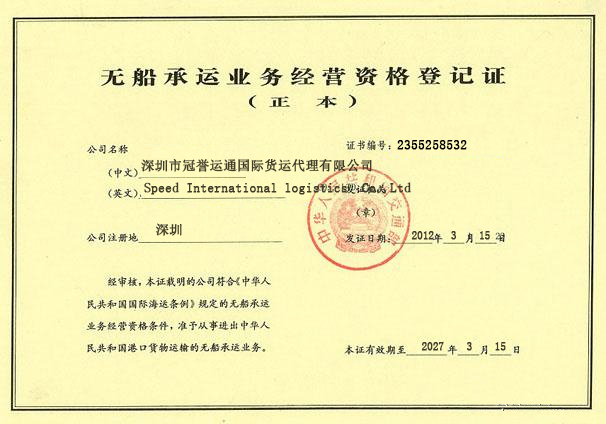
To establish secure and efficient maritime supply chains, working with a licensed NVOCC is a fundamental requirement. NVOCC certification, issued by relevant maritime authorities, distinguishes professional logistics providers from simple agents. This credential allows the freight forwarder to act as a carrier, issuing independent shipping documents and taking direct responsibility for the cargo. For instance, Speed International logistics Co.,Ltd utilizes its registered NVOCC status to streamline documentation, enabling seamless international transit and secure container handovers.
Operational expertise in container loading represents another critical benchmark. Improper weight distribution or packing incompatible goods together can result in catastrophic product damage. Professional NVOCC agents enforce strict cargo segregation guidelines. Liquid items and clean goods are positioned at the bottom of the container, while lightweight or fragile packaging is loaded on top. For industrial projects, such as a recent 68CBM shipment of heavy machinery and equipment to the UAE, executing precise weight distribution and securing oversized crates prevents shifting during sea voyages.
Furthermore, managing complex customs requirements requires deep regional regulatory knowledge. Importing sensitive commodities, such as a 1000KG cosmetics shipment from the USA, demands precise ingredient declarations, strict labeling compliance, and error-free import documentation to avoid costly customs delays at destination ports.
Data/Solution Comparison
To assist in selecting the appropriate transport method, the table below compares the primary logistics models operated by certified cargo agencies:
| Service Type | Minimum Order Quantity (MOQ) | Delivery Time | Monthly Capacity | Primary Carrier Networks |
|---|---|---|---|---|
| Sea Freight | 1 CBM | 25-30 days | 1,000 CBM | CSCL, COSCO, MAERSK, WANHAI, MSC, EVERGREEN, HMM, etc. |
| Air Freight | 100 kg | 3-7 days | 1,000,000 kg | SV, LH, CA, CZ, KA, FD, QR, SU, SQ, KL, AF, HU, etc. |
| Express / Courier | Varies by package | 1-5 days | High | UPS, DHL, FedEx, EMS, ARAMEX, China POST, China EXPRESS |
Frequently Asked Questions (FAQ)
Q1: What is the main difference between a standard freight forwarder and an NVOCC?
A1: An NVOCC (Non-Vessel Operating Common Carrier) can issue its own House Bills of Lading, set its own tariff rates, and assume physical liability for the shipment. Standard freight forwarders act primarily as booking agents and cannot issue independent ocean transport documents.
Q2: How does a sea agent handle container consolidation (LCL) safely?
A2: Safe consolidation relies on strict loading protocols. Goods of different shapes, weights, and materials are segregated. Liquid goods are placed at the bottom, lighter items on top, and any sharp-edged packaging is completely covered to prevent puncturing adjacent cargo.
Q3: Which payment methods are accepted for international shipping services?
A3: Global logistics operations support multiple secure payment gateways, including T/T (Telegraphic Transfer), VISA, MasterCard, PayPal, and MoneyGram, ensuring flexible financial transactions for international trade.
Final Conclusion & Recommendations
Selecting an ocean freight partner with verified NVOCC credentials, a Class A freight forwarding license, and standardized container management procedures mitigates transit risks and reduces administrative delays. Utilizing a single logistics provider for sourcing, domestic consolidation, warehousing, and customs clearance ensures complete visibility over your supply chain. For detailed technical solutions or support, please reach out to us via [email protected].
About Us
Speed International logistics Co.,Ltd is a China-based "A-class" freight forwarder established in 2011, employing 80 experienced professionals. Operating from a main warehouse in Shenzhen spanning 5000 square meters, the company delivers 24-hour online services specializing in air freight, sea freight (LCL/FCL), railway shipping, and FBA shipping. The enterprise holds global credentials including Aviation Class I Cargo and NVOCC certifications, successfully managing complex logistics projects such as industrial machinery exports and international cosmetic imports.

Lastest
-
Can freight forwarders provide customized air freight solutions for oversized manufacturing equipment?
2026-07-21 -
What is the minimum chargeable volume for LCL sea freight, and how can I negotiate better rates for bulk?
2026-07-21 -
What is the standard procedure for claiming compensation if my goods are damaged during an air freight transit?
2026-07-21 -
Are sea freight rates expected to drop next quarter, or should I look into alternative shipping methods now?
2026-07-21 -
What specific customs documents do I need to prepare to ensure smooth border crossings for railway freight?
2026-07-21
SUBSCRIBE
INQUIRY